

Wedding Guest Transport in Henley: Solve the Return-Ride Problem starts with planning every guest’s journey home, not just getting everyone to the venue. Nestled along the River Thames, Henley-on-Thames is a charming setting for a wedding, and a clear transport plan helps guests enjoy the day without uncertainty about their return ride.
Key Takeaways
- How should we count wedding transport passengers? Count likely passengers separately for each journey, pickup point and destination rather than using the invitation total.
- Which vehicle suits our guest groups? Match the vehicle to group size, route access, boarding needs and the number of destinations, not seat count alone.
- How do we avoid unrealistic return times? Allow for driving, loading, drop-offs, turnaround and the return to the next pickup point.
- Should we offer fixed departures or a shuttle loop? Fixed departures suit guests with clear destinations and times; a repeat loop can work when people leave gradually, provided you plan the full circuit.
- How do we help guests who need to leave early? Include an early return option and allow suitable boarding time for guests with accessibility requirements.
- What should guests receive? Send each group its pickup point, departure time, destination and transport contact in one current message.
Map every journey and count passengers by leg
Start with a route map for the ceremony, reception, accommodation and likely return destinations. These may be different places, and a guest who needs a lift to the ceremony may not need the same ride back.
Count the passenger headcount for each leg and pickup point separately. The number on your invitation list is not a reliable shuttle count: some guests travel independently, some share a lift, and others stay in different locations.
Then group return passengers by both destination and preferred departure time. A plan that assumes everyone wants to leave together for one hotel can leave guests waiting or send a vehicle on an inefficient route.
Ask guests about early departures and individual boarding needs as you collect transport requirements. Their answers help shape the journey schedule while there is still time to organise suitable vehicles and timings.
We recommend writing each leg in a simple list, with the pickup point, destination, expected passengers and preferred time beside it. This makes gaps easier to spot, especially when guests need transport between accommodation and the ceremony as well as a separate return journey after the reception.

Match the vehicle to the group and the journey
A coach can carry a large group together, while minibuses offer more flexibility for smaller parties or several destinations. Using several vehicles can serve different groups and times, but it also adds coordination: each vehicle needs its own route, loading plan and guest instructions.
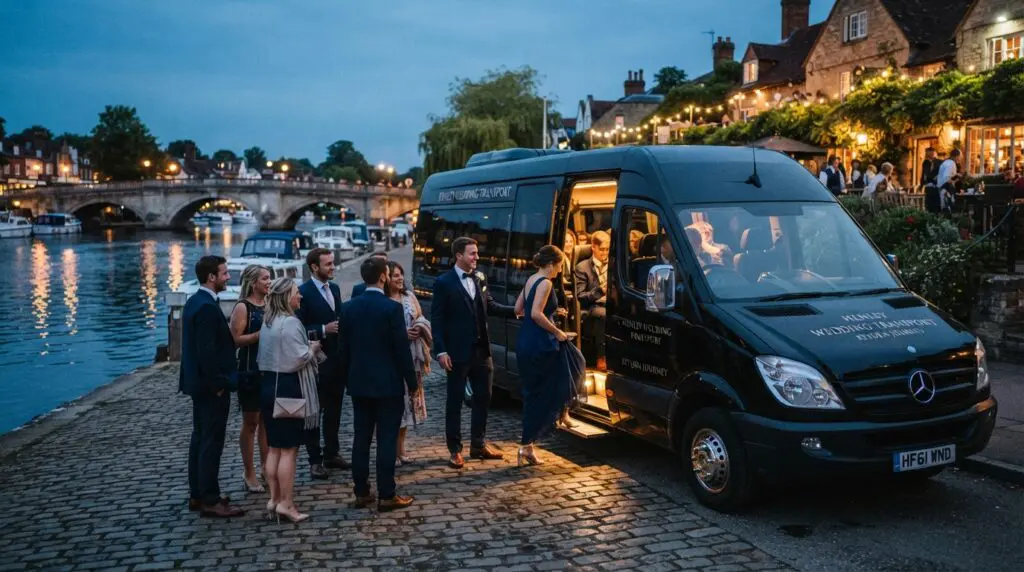
For smaller or separate groups, a car or MPV can be more suitable than sending a larger vehicle on a lightly loaded run. The Ford Galaxy MPV and Mercedes Vito MINI BUS are different vehicle types, making them relevant when weighing up these approaches.
Henley event transport needs to suit the venue as well as the passenger count. Check the approach route, turning space, safe loading location and any venue restrictions with the venue and transport operator, since a vehicle that fits the group must also be able to reach and serve the pickup point safely.
For a wedding with several guest groups, Event Hire Services provides vehicles and chauffeurs for social events, with 5-, 6-, 7- and 8-seater taxis or minibus hire. That range is useful when comparing a shared ride for a larger party with smaller vehicles for guests travelling to different places.
Keep different destinations and departure times in view when choosing. One large vehicle may be less practical if some guests need to leave early or travel to separate accommodation, while multiple smaller vehicles may require more careful coordination.
Did You Know?
Local buses carried 4 billion passenger journeys in Great Britain in the year ending March 2025.
Source: Department for Transport
Build realistic travel and loading time into the schedule
Allow for the actual road journey and for guests to board and alight at each stop. A vehicle cannot begin its next run the moment it reaches a pickup point, so include enough loading time for passengers to find the vehicle, get settled and leave safely.
For repeat runs, count the complete cycle: the journey to the drop-off, time for passengers to get out, the return to the pickup point and the next boarding period. This turnaround time determines when another group can realistically be collected.
The minibus hire in Henley service offers minibus hire for groups, families and longer journeys, with customers able to choose travel times and places and request stops along the way. That makes it relevant when your planned trip includes agreed stops or different locations, which should be built into the timetable rather than added without considering the effect on later pickups.
The Mercedes Vito is a MINI BUS. A minibus can be considered for a group journey with planned stops, but the route and turnaround still need to fit the agreed schedule.
Before settling the timetable, ask the venue and operator where vehicles can approach, wait and load safely. Also agree whether venue access or event timings place limits on pickups, and plan the route order in advance if guests are travelling to several destinations.
For each run, write down the departure time, expected journey, loading period and next planned arrival. This gives you a practical way to test whether the schedule allows for the full route instead of relying on back-to-back collection times.
Choose fixed returns or a shuttle loop
Fixed return departures work well when guests have clear destinations and preferred leaving times. Tell each group its departure time and pickup point so guests know which ride to take and the driver can follow an agreed plan.
A repeat shuttle loop can suit a reception where guests leave gradually. Work out the full loop time, including boarding and every stop, then tell guests how the service will run so they can make an informed choice about waiting.
| Return approach | Best suited to | Plan clearly |
|---|---|---|
| Fixed departures | Groups with a shared destination and agreed leaving time | Each departure time, destination and pickup point |
| Repeat shuttle loop | Guests leaving at different times across the evening | Full circuit time, stop order and realistic waiting expectations |
When guests are staying at several hotels or locations, group stops by destination and make the route order clear. Treating every return as one journey to a single hotel can make the plan confusing for guests and difficult to timetable.
Check both patterns against the actual reception finish. Guests often leave gradually, and a late finish can affect which departures remain workable, so decide in advance which runs can still operate if the event ends later than planned.
For wedding guest journeys, minibuses and executive cars are offered as transport options. They can form part of a plan that separates shared guest transfers from smaller, distinct journeys, depending on the destinations and departure pattern you agree.
Some guests may also make their own arrangements for part of the journey. The infographic below is a reminder to consider public transport when planning how guests will travel home.
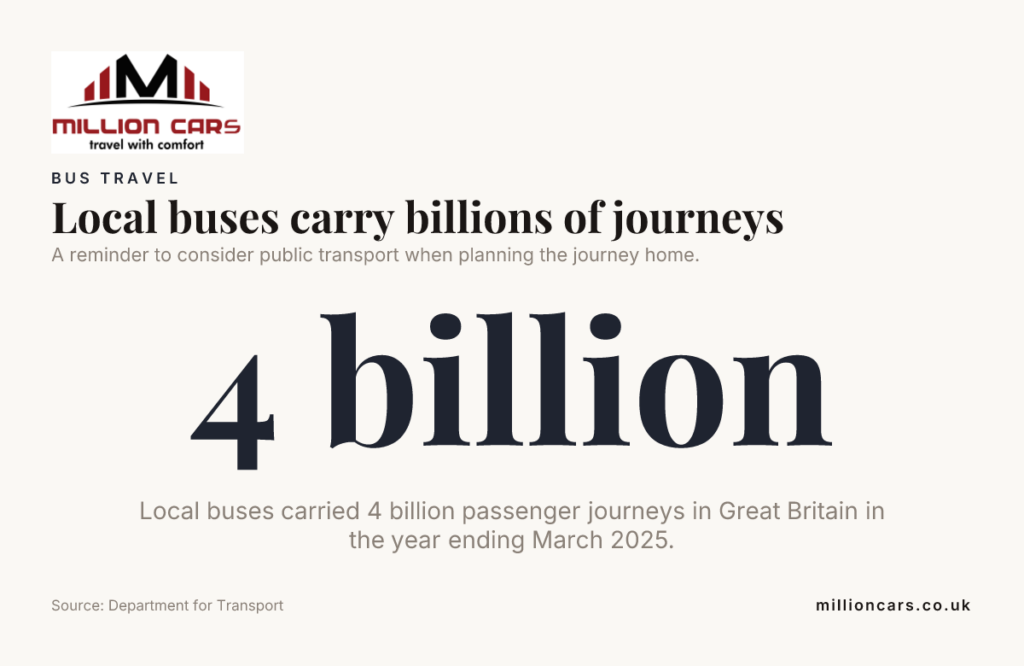
A reminder to consider public transport when planning the journey home.
Source: Department for Transport

Plan for accessibility and guests leaving at different times
Ask guests privately about mobility, step-free boarding or other assistance needs, then agree suitable vehicles and boarding arrangements with the operator. This lets you plan around individual requirements with care and gives guests a clear understanding of the arrangements.
Do not make the last departure the only return option. Provide a clear way for guests who need to leave early to travel back, and allow enough boarding time for anyone who needs additional assistance.
Choose a pickup point that guests can reach safely and comfortably. Consider the distance from the reception entrance, the surface underfoot and whether guests who cannot wait standing for a long period have a practical place to wait.
Accessibility requirements belong in the operating plan, not as an afterthought on the night. Agree who will help coordinate boarding and how the driver will identify the correct pickup point, then share those arrangements directly with the guests who need them.
Did You Know?
Looking at data for 2018 and 2019 combined, 79% of people with a disability and 83% of people without a disability rated ease of ticket purchase ‘very or fairly good’.
Source: Office for Statistics Regulation
Share clear instructions and agree a change plan
Send each guest group one clear message with its pickup location, departure time, destination and transport contact. If any detail changes, replace the earlier instructions so guests are not left choosing between conflicting messages.
Name one transport coordinator to handle guest questions and pass agreed changes to the operator on the day. A single contact keeps decisions clear and helps prevent different guests from giving the driver conflicting directions.
Before the wedding, agree what happens if the reception runs late or a guest misses a return departure. Identify who makes the decision, how the coordinator contacts the operator and whether another departure or separate arrangement can be made.
When arranging the service, establish the agreed operating hours, planned return runs and the process for extra journeys or additional stops. Set a process for extra journeys or additional stops that accounts for the route and other guests’ timings.
A written operating plan should set out the agreed destinations, stop order, pickup points and any timing limits. It gives the couple, coordinator and transport team one shared reference for the day, including when a guest needs help or a delay changes the expected running order.
Frequently Asked Questions
Should guests RSVP for a seat on the wedding transport?
Yes, ask guests to respond by a stated deadline and indicate whether they need a seat for the outward journey, the return journey or both. A transport response lets you allocate seats against the final passenger list rather than treating attendance at the wedding as a seat reservation.
How early should guests arrive at the pickup point?
Ask guests to arrive before their stated departure so they can find the correct vehicle and be ready to board. Give the same arrival guidance to each group in its travel message, particularly when different vehicles use separate pickup points.
What should couples do if a guest’s accommodation changes after the transport plan is shared?
Ask the guest to tell the transport coordinator directly, rather than relying on the change to reach the driver through another passenger. The coordinator can then assess whether the new address fits the agreed route and tell the guest which confirmed arrangement applies.
Can guests bring luggage or a pushchair on a wedding shuttle?
Ask guests to mention luggage or a pushchair when they respond for transport, since these affect the space needed on board. Share the number and type of items with the operator when agreeing the vehicle and passenger arrangements.
What should guests do if they miss their planned return ride?
They should contact the named transport coordinator using the number in their travel message, rather than asking the driver to change the route without agreement. The coordinator can follow the pre-agreed missed-departure procedure and tell the guest the next available option.
Planning
Wedding Guest Transport in Henley: Solve the Return-Ride Problem by planning the return as carefully as the outward journey. Count passengers by leg, match vehicles to group needs and venue access, and allow realistic time for travel, loading and turnaround.
Clear departure choices, accessible pickup arrangements and one reliable transport contact help guests enjoy the celebration without uncertainty about getting home. With each destination and change process agreed in advance, we have you covered for a more seamless wedding journey.
Book your Transport Today
Send us an email at reservations@millioncars.co.uk or call us on 01491 414140.
Or use our Contact Form